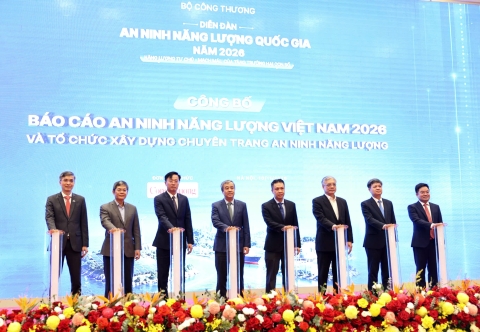
On the morning of November 10, 2026, representatives from KLINOVA Climate Innovation Consulting & Services attended the National Energy Security Forum 2026 at the International Convention Center in Ha Noi. The event served as a high-level strategic dialogue, convening nearly 500 delegates to formulate solutions for safeguarding energy security and accelerating the green transition toward Viet Nam’s goal of double-digit economic growth.
The National Energy Security Forum 2026 marks the inaugural annual conference held in implementation of Resolution No. 70-NQ/TW and under the direction of Prime Minister Le Minh Hung and Minister of Industry and Trade Le Manh Hung. Presided over by the Newspaper of Industry and Trade (Báo Công Thương), the forum was co-organized by the Electricity Authority of Viet Nam, the Energy - Petroleum Agency, the Agency for Domestic Market Surveillance and Development, the Department for Science, Technology and Digital Transformation, and the Institute of Energy, alongside key state-owned energy corporations including Viet Nam Electricity (EVN), the Viet Nam National Industry - Energy Group (Petrovietnam), the Viet Nam National Coal and Mineral Industries Group (Vinacomin), the Viet Nam National Petroleum Group (Petrolimex), and the National Power System and Market Operation Company Limited (NSMO). Under the theme "Self-reliant energy - the lifeblood of double-digit growth," the forum brought together senior Party and National Assembly leaders, central and local government officials, leading energy economists, financial institutions, and international diplomatic missions.
At the forum, the Ministry of Industry and Trade (MOIT) officially released the Viet Nam National Energy Security Report 2026. The report affirms that 2026 was the year in which Viet Nam’s energy system suffered its biggest shock in decades—from the six-month blockade of the Strait of Hormuz pushing Brent crude prices to USD 118.35 per barrel, to record heatwaves and El Niño driving electricity loads to an all-time high while reducing hydropower output by approximately 18.5 billion kWh. Despite these headwinds, Viet Nam achieved a remarkable governance milestone, ranking among only 13 of 177 surveyed nations to maintain energy stability. The power system withstood three extreme heatwaves without rolling power cuts—reaching a record peak capacity of 57,537 MW and an estimated full-year output of 356.2 billion kWh—while domestic petroleum supply remained resilient, prices were stabilized, and the nationwide rollout of E10 bio-gasoline contributed to cutting around 2.5 million tons of CO2 annually.
A key highlight drawing significant attention from the business community during the discussions was the address by Mr. Tran Hoai Trang, Deputy Director General of the Electricity Authority of Viet Nam. He emphasized the critical need to establish and formalize the legal legitimacy of Renewable Energy Certificate (REC) transactions within the draft amended Electricity Law.
Completing the legal corridor for RECs is vital for verifying renewable energy attributes and providing a transparent mechanism for manufacturers, particularly Foreign Direct Investment (FDI) enterprises, to substantiate Scope 2 emissions reductions from electricity consumption. This framework equips businesses with credible credentials to meet stringent environmental standards and enhance their competitiveness in global supply chains. The draft amended Electricity Law is scheduled to be reviewed and passed by the National Assembly on November 20, 2026.
Summarizing the forum’s strategic orientations, Deputy Minister of Industry and Trade Nguyen Viet Son reaffirmed that energy remains the lifeblood of economic expansion and the foundation of economic self-reliance. Incorporating insights from the event, the MOIT will focus on five strategic priority pillars: perfecting institutional and financial mechanisms; guaranteeing sufficient electricity supply for the 2027–2028 period; strengthening fuel self-reliance and national reserves; advancing forecasting and data-driven management via the National Energy Information System launching in 2027; and accelerating the energy transition alongside capital mobilization, energy efficiency, and technological self-reliance.
Notably, energy efficiency has been identified as the fastest and most cost-effective "power source" for the upcoming period. The MOIT has set a mandatory national electricity-saving target of at least 3% per year and launched a Demand-Side Management (DSM) campaign aimed at reducing peak load capacity in northern Viet Nam by a minimum of 3,000 MW in 2027. These targets call for proactive engagement and shared responsibility from both regulatory authorities and energy-consuming enterprises.
KLINOVA believes that energy security and the green transition are not merely national strategic imperatives, but the core drivers determining the long-term competitiveness of every enterprise in the new era. Anticipating these pivotal institutional advancements from the Ministry of Industry and Trade, KLINOVA is committed to leveraging its core values of innovation, practical technical expertise, and comprehensive partnership to help businesses proactively navigate the green transformation roadmap.
Through these dedicated efforts, KLINOVA aims to empower enterprises to unlock green finance, optimize operational models, and contribute meaningfully to national energy security and Viet Nam’s journey toward a carbon-neutral economy.


_cr_480x332.jpg)
_cr_480x332.png)
_cr_480x332.png)