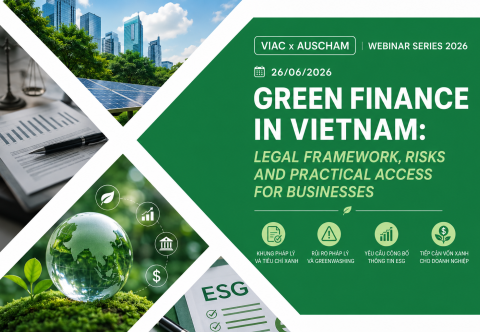
Green Finance in VietNam - Legal framework, risks and practical access for businesses
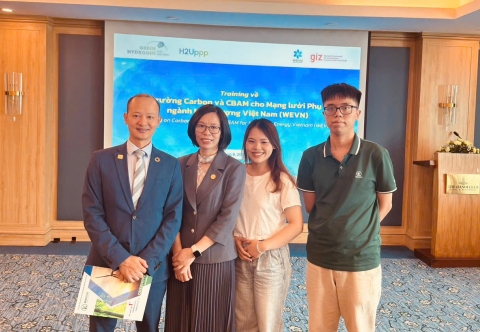
As part of the VIAC x AUSCHAM Webinar Series 2026, held on 26 June 2026 under the theme "Green Finance in Vietnam: Legal Framework, Risks and Practical Access for Businesses," a panel discussion on legal risks, disclosure requirements, and risk management strategies for accessing green finance brought together experts from the legal and sustainability consulting sectors.
Moderated by Ms. Huyen Pham (IFC), Dr. Nguyen Phuong Nam, General Director of KLINOVA Climate Innovation Consulting & Services, shared practical insights into the barriers Vietnamese businesses continue to face in accessing green finance.
Bridging the gaps in access to green finance
According to Dr. Nguyen Phuong Nam, the greatest challenge today is not the shortage of green capital, but rather the limited capacity of businesses to prepare projects that meet sustainable finance requirements. While conventional lending often involves banks supporting borrowers in completing documentation and assessing financial viability, green finance requires businesses to proactively demonstrate that their projects satisfy environmental criteria through credible data, performance indicators, and verifiable evidence.
This means that companies must not only develop financially viable investment plans but also quantify the environmental benefits of their projects, such as greenhouse gas emission reductions, energy savings, or more efficient resource use. In practice, however, many businesses remain focused on identifying preferential financing opportunities while investing insufficient effort in developing robust data systems, technical documentation, and evidence demonstrating the environmental credentials of their projects. As a result, many promising projects fail to meet the due diligence requirements of financial institutions.
Although Decision No. 21/2025/QD-TTg, Vietnam's Green Taxonomy, has provided an important regulatory foundation, its implementation still requires more detailed technical guidance and a consistent verification mechanism. During this transitional period, financial institutions may apply different assessment methodologies, while many businesses continue to face challenges in obtaining independent certifications - such as ISO standards or sector-specific certifications - to strengthen the credibility of their projects.
Dr. Nam also highlighted that Vietnam's green finance ecosystem still lacks sufficient advisory firms with expertise in ESG, greenhouse gas accounting, and project structuring in line with international standards. This capacity gap increases both the cost and time required for project preparation and ultimately limits businesses' access to green finance, particularly for small and medium-sized enterprises (SMEs) with constrained resources.
Another important issue is the current allocation of risks within green finance transactions. At present, the primary responsibility for demonstrating compliance with environmental criteria and mitigating greenwashing risks largely falls on businesses. This underscores the need for further improvements in the legal framework, technical standards, and verification mechanisms to establish greater consistency across the market while reducing compliance costs for companies.
ESG is becoming a prerequisite for accessing capital
For hard-to-abate sectors, Dr. Nam emphasized that ESG is increasingly becoming the common language between businesses and investors. As international capital markets continue to prioritize sustainable investments, ESG disclosure is no longer merely a voluntary practice but an increasingly important component of investment due diligence and decision-making. The transparency of ESG data and an organization's ability to manage environmental, social, and governance risks play a critical role in building confidence among financial institutions and investors.
However, Vietnam still lacks internationally recognized ESG verification bodies and ESG rating agencies. This creates significant challenges for businesses seeking to assess, validate, and standardize ESG information when accessing international sources of finance.
Starting with practical and achievable steps
One of Dr. Nguyen Phuong Nam's key messages was that businesses do not need to wait until their ESG systems are fully developed before beginning their sustainability journey. Instead, companies should prioritize preparing project documentation supported by independent third-party verification while progressively disclosing core ESG indicators. According to Dr. Nam, meeting approximately 20 - 30% of ESG disclosure requirements already provides a solid foundation for building trust with financial institutions and investors.
This perspective reflects a pragmatic approach for Vietnamese businesses, particularly SMEs. Rather than striving for perfection from the outset, companies should adopt a phased transition roadmap, beginning with the most fundamental requirements and continuously strengthening their governance capabilities over time. As sustainability standards increasingly become a market expectation, taking proactive steps today will enhance businesses' ability to access green finance and strengthen their long-term competitiveness.


_cr_480x332.png)
_cr_480x332.jpg)

_cr_480x332.JPG)