On 4 June 2026, in Cua Lo Ward, Nghe An Province, the United Nations Development Programme (UNDP), the Vietnam Agency of Seas and Islands (VASI) under the Ministry of Agriculture and Environment, with financial support from the Government of Norway and technical advisory support from KLINOVA, convened an event to review the achievements of Phase I of the Marine Spatial Planning (MSP) Programme and announce the latest research findings. The event marked an important milestone in advancing the implementation of Resolution No. 36-NQ/TW (2018) on the Sustainable Development Strategy for Vietnam’s Marine Economy. The strategy aims to increase the marine economy’s contribution to approximately 10% of national GDP by 2030, while transitioning from a traditional resource extraction model towards innovation-driven and ecosystem based development pathways. Phase 1 of the MSP Programme has now concluded and delivered a number of notable outcomes.

Presenting the conceptual framework, Dr. Jeremy Hills (Lead Researcher, UNDP) and Dr. Cao Le Quyen from the Centre for Fisheries Economics and Planning (CFEP) outlined four key approaches underpinning blue economy development: (i) an ecosystem-based approach to ensure the sustainable use of marine resources; (ii) a multi-sectoral and value chain approach to optimise linkages from production to consumption; (iii) a value-based approach that balances economic, environmental, and social objectives; and (iv) a readiness-based approach that assesses institutional, financial, technological, and organisational capacities.
Based on assessments conducted by experts from CFEP and VAFIS, six priority Blue Business Model (BBM) categories were identified and evaluated:

According to Mr. Dao Viet Long (CFEP), the overall readiness of Blue Business Models in Vietnam is currently assessed as moderate to relatively advanced. However, several critical bottlenecks remain. These include the lack of flexible financing mechanisms capable of transforming policy ambitions into bankable projects, insufficient environmental carrying-capacity data and internationally aligned Measurement, Reporting and Verification (MRV) systems, as well as fragmented coordination among ministries and local authorities.
To unlock the full potential of Blue Business Models, experts proposed several key recommendations:
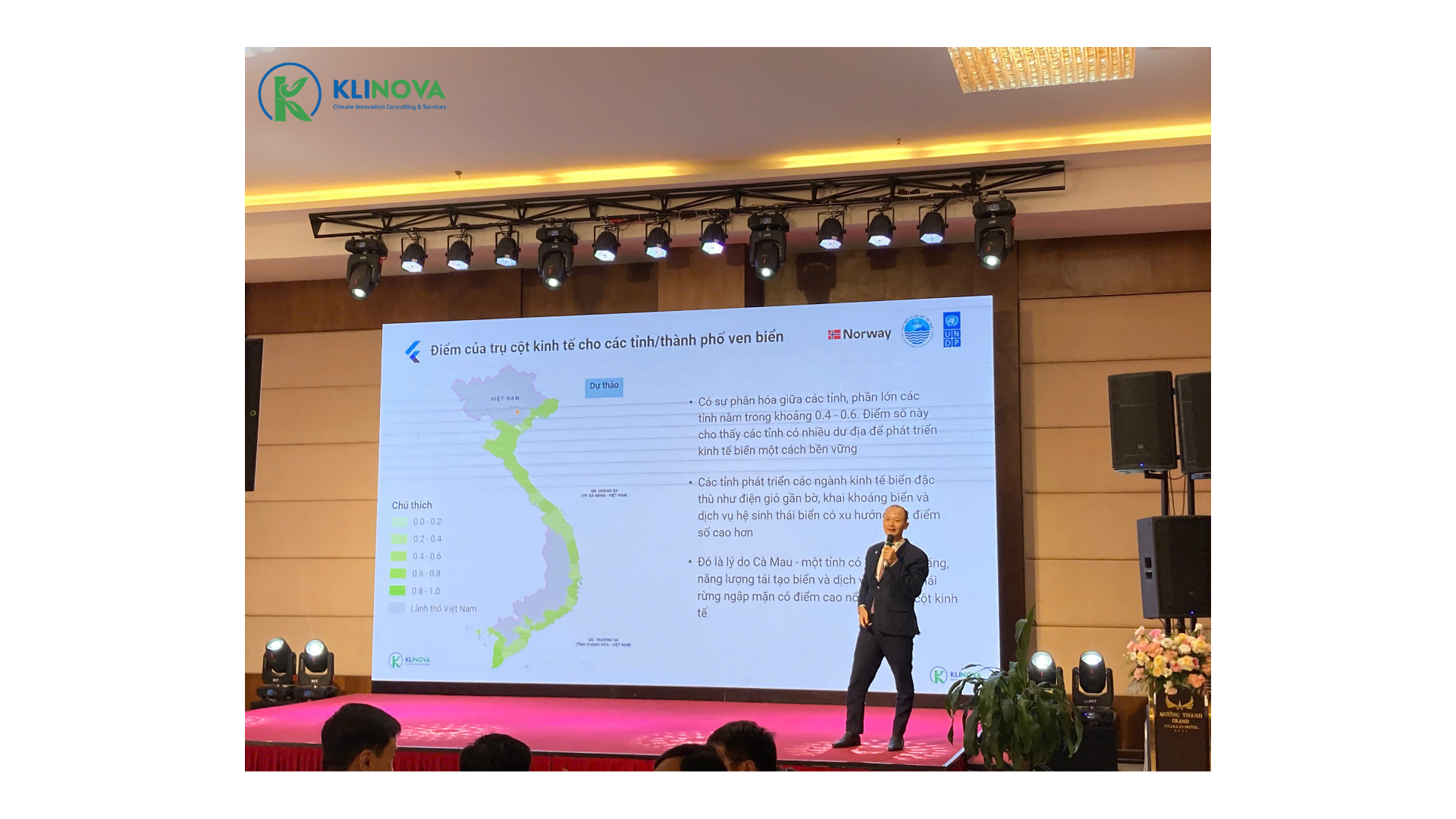
During the conference, Dr. Nguyen Phuong Nam, Chief Executive Officer of KLINOVA Climate Innovation Consultancy and Services JSC, presented on the topic: “International Experiences in Developing the Blue Economy Development Index (BEDI) and Recommendations for Vietnam.”
Methodology for Developing the Vietnam Blue Economy Index (VN-BEI):
Experts at the conference emphasised that the development of Blue Business Models represents a long-term transformation process. By decoupling economic growth from environmental degradation, these models can support a more resilient, inclusive, and sustainable future for Vietnam’s coastal communities and contribute to the country’s vision for sustainable marine prosperity by 2045.
_Bao Le_


_cr_480x332.jpg)
_cr_480x332.JPG)