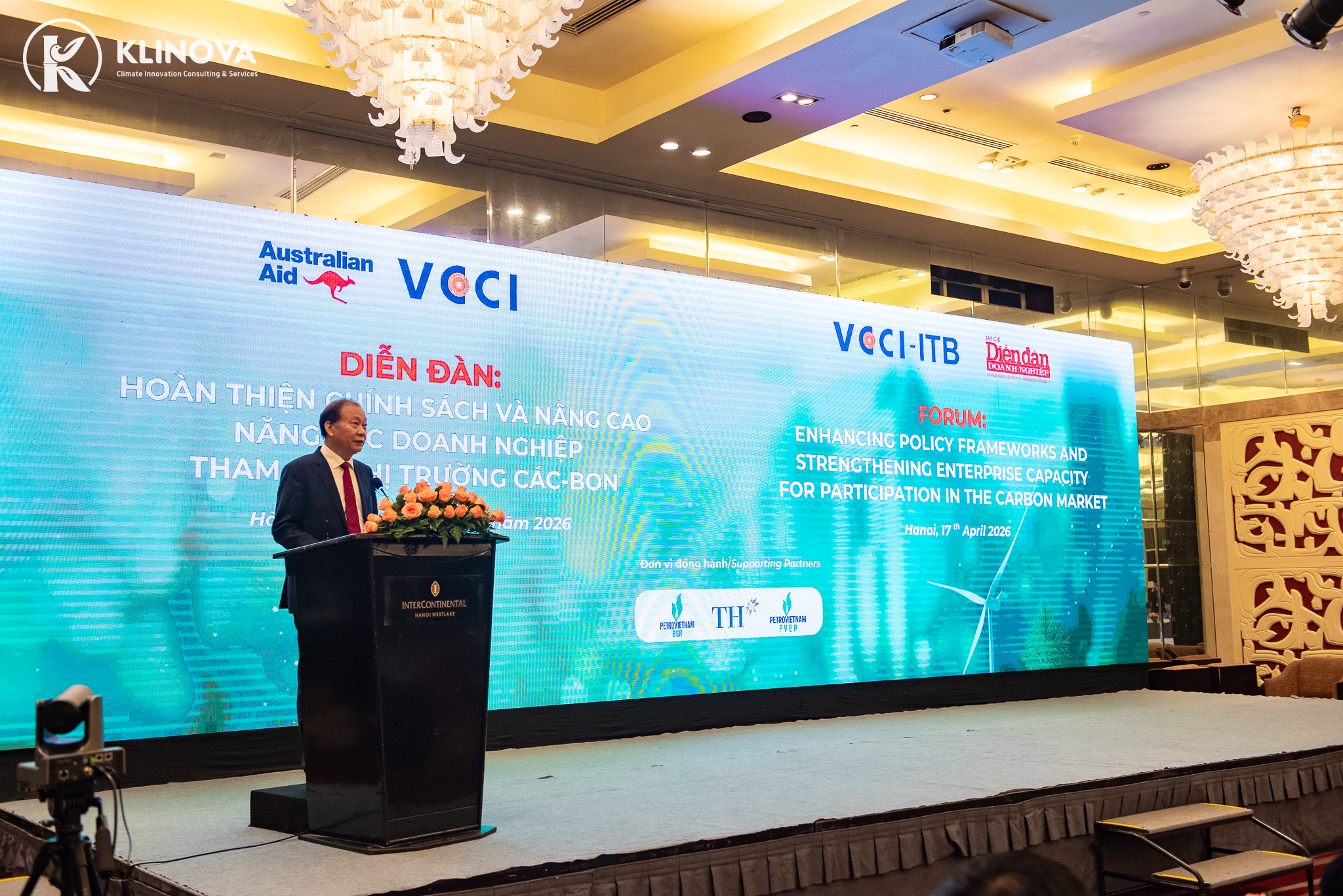
The forum “Enhancing Policy Frameworks and Building Business Capacity for Participation in the Carbon Market,” organized by Vietnam Chamber of Commerce and Industry (VCCI), took place on April 17, 2026 at InterContinental Hanoi Westlake, against a backdrop of significant policy developments shaping Vietnam’s carbon market.
Recently, a set of new decrees and regulations have been issued, gradually establishing the legal foundation for market operations-from greenhouse gas (GHG) inventories and emissions quota allocation to the roadmap for developing a domestic carbon exchange. Notably, Decree 29/2026/ND-CP on the domestic carbon trading platform has just been promulgated, contributing to the completion of market infrastructure and clarifying the pathway toward operationalization. These developments signal Vietnam’s transition from a preparatory phase to early-stage implementation, laying a more structured and predictable foundation for business participation.
During the morning session, discussions focused on clarifying the policy landscape and bridging the gap between regulation and implementation. Government representatives provided updates on the direction of carbon market development, while emphasizing the need for businesses to proactively build capacity-from measurement, reporting and verification (MRV) systems to sector-specific decarbonization strategies. International experience, particularly from Australia, was also shared to offer reference points for Vietnam’s market design. The panel discussion that followed facilitated candid exchanges among policymakers, experts, and businesses on practical challenges, ranging from compliance costs to access to international carbon credit mechanisms.
At this panel, Dr. Nguyễn Phương Nam – CEO of KLINOVA, Vice Chairman of HBGA – delivered a notable perspective by approaching the carbon market through a business lens. According to him, most companies today are not entering the market as obligated buyers of credits to offset emissions, but rather as potential suppliers seeking to generate carbon credits as a tradable commodity. This reframing shifts the carbon market beyond a purely regulatory instrument into a value-driven marketplace, where businesses must strategically evaluate standards, market access, and transaction mechanisms to optimize returns.
From this standpoint, he noted that the value of a single carbon credit can vary significantly across markets. While domestic transactions currently yield relatively low prices, credits certified under international standards can command substantially higher values, with certain niche credit types reaching premium levels. This implies that businesses must go beyond technical capability in generating credits-they also need a clear understanding of market structures and must strategically choose their point of sale. In this sense, carbon becomes a matter of resource allocation and value optimization, similar to any other commodity market.
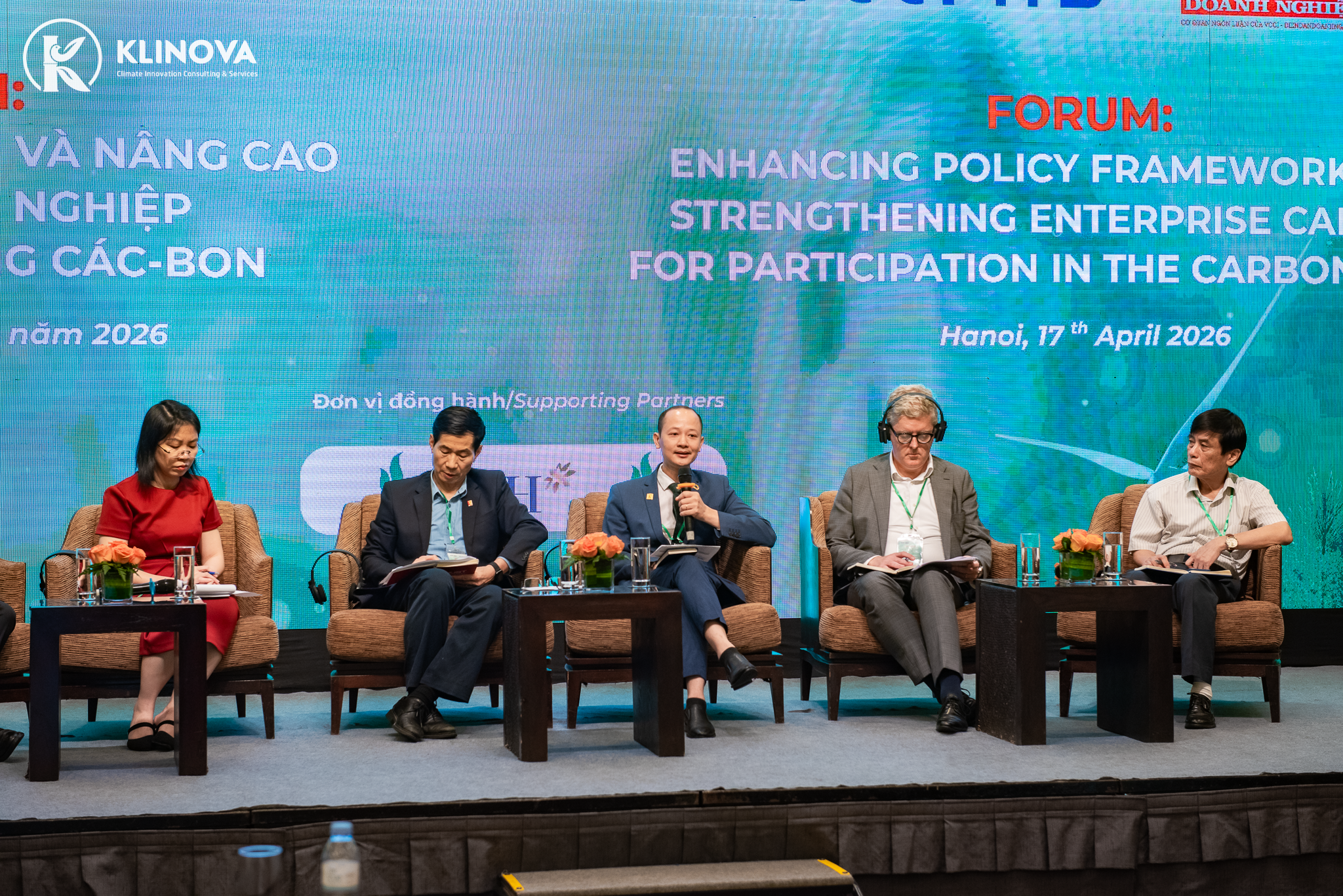
Dr. Nguyễn Phương Nam (in the middle) – CEO of KLINOVA, Vice Chairman of HBGA, sharing about Viet Nam Carbon Market
Dr. Nam further emphasized that Vietnamese businesses are, in fact, more prepared than often perceived-particularly under pressure from export markets and global supply chains. Many companies have already begun transitioning, not only to meet compliance requirements but also to enhance product value. However, for this transition to scale effectively, the decisive factor lies in top-level leadership commitment, alongside a sufficiently stable policy environment to reduce risk and support long-term investment decisions.
In the afternoon session, the forum shifted focus toward the development and commercialization of carbon projects. International experts and technical organizations shared insights on project design, ensuring credit integrity, as well as verification and issuance processes. Key topics included developing projects aligned with international standards, carbon credit pricing mechanisms, and engaging buyers in an increasingly active voluntary carbon market. At the same time, discussions on demand signals, policy drivers, and market risks provided businesses with a more grounded understanding of the opportunities and constraints surrounding carbon credit commercialization in the near term.

Overall, the forum highlighted a clear transition phase for Vietnam’s carbon market-from policy formation toward operationalization, and from awareness to action. As the legal framework continues to take shape, the business community is demonstrating growing proactiveness in exploring opportunities within this emerging market. The intersection between policy and market, if effectively designed, will not only support Vietnam in achieving its climate commitments but also unlock a new avenue for economic growth-one where businesses can generate value from their own green transformation.
- Huu Hoang -


_cr_480x332.jpg)


_cr_480x332.jpg)


_cr_480x332.JPG)