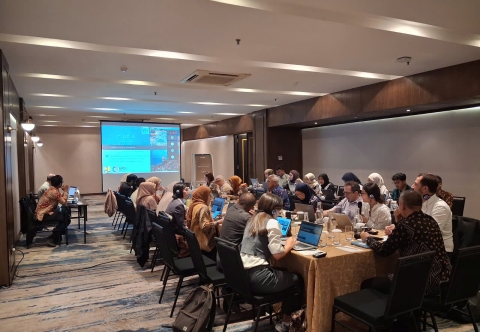
On 20 November 2026, in Jakarta, Indonesia, MSc. Nguyen Thi Minh Hue, Project Director at KLINOVA Climate Innovation Consulting & Services, participated in the Consultation Workshop on the Enhancement of Guidelines for the Development of the Municipal Solid Waste Master Plan (RISPS). She joined the workshop as an Expert on Waste Management and Greenhouse Gas (GHG) Planning.
Organized by the Directorate General of Human Settlements (Cipta Karya) under Indonesia’s Ministry of Public Works, with funding from the French Development Agency (AFD), the workshop marked an important step towards transforming waste management across Indonesia’s 38 provinces. The initiative aims to establish a more integrated, circular and sustainable waste management system, while embedding GHG emissions reduction into long-term national planning.

The workshop forms part of an eight-month technical assistance project running from September 2026 to April 2027, under the Marine Debris Policy-Based Loan Programme (Sub-program 3). At its core, the project seeks to redefine RISPS (the Municipal Solid Waste Master Plan) beyond its traditional role as a technical planning instrument primarily focused on landfill development. Instead, it is envisioned as a comprehensive framework for strategic coordination, investment planning and monitoring Indonesia’s climate commitments over a 20-year horizon.
The revised guidelines will be aligned with Indonesia’s National Medium-Term Development Plan (RPJMN 2025–2029) and National Long-Term Development Plan (RPJPN 2025–2045), ensuring consistency between waste management priorities and the country's broader development objectives.
As an Expert on Waste Management and GHG Planning, MSc. Nguyen Thi Minh Hue worked alongside other project specialists to address a critical gap in the previous RISPS guidelines issued in 2016 and 2023: the lack of systematic integration of greenhouse gas (GHG) considerations, circular economy principles and Extended Producer Responsibility (EPR). These elements are particularly important in light of the 41 new requirements introduced under Indonesia's National Medium-Term Development Plan.
Bringing together representatives from key Indonesian government agencies – including the Ministry of Public Works, the Ministry of National Development Planning (Bappenas), the Ministry of Environment, the Ministry of Home Affairs and the Coordinating Ministry for Food Affairs – alongside major development finance institutions such as AFD, ADB and KfW, the workshop focused on refining and reaching consensus on three fundamental components of the new guidelines:
1. Restructuring the planning framework Establishing a standardized process for preparing and reviewing master plans every five years, within a 20-year strategic outlook. The revised framework will ensure regulatory consistency with Ministerial Regulation Permen PU No. 03/2013, which is currently undergoing revision, while providing a harmonized approach to implementation across all 38 provinces.
2. Standardizing planning requirements across 15 core components Moving away from a landfill-centred approach towards a system in which only residual inert waste is sent to landfills after treatment. This transition supports Indonesia's ambition to increase its waste treatment rate from 24% to 38% during the 2025–2029 period. The new planning framework will also incorporate comprehensive assessments of environmental and social impacts, circular economy opportunities and GHG emissions reduction.
3. Developing practical planning and assessment tools Building on and upgrading existing resources, the consulting team proposed the development of several additional tools, including a GHG Emissions Calculator, a financial modelling tool covering capital and operational expenditure (CAPEX/OPEX), a risk assessment matrix and a market assessment tool for recycled products.
Together, these tools will provide local authorities with a stronger evidence base to assess the environmental, climate and financial viability of proposed waste management solutions before seeking investment. In particular, the ability to quantify GHG emissions will help ensure that climate considerations are translated into measurable planning outcomes rather than remaining broad policy commitments.
MSc. Nguyen Thi Minh Hue's participation as part of the international expert team of Espelia–BERIM in this AFD-funded, national-level initiative reflects her specialized expertise in GHG inventories and emissions reduction planning for the waste sector. It also marks a significant milestone for KLINOVA, demonstrating the company's growing role in bringing Vietnamese climate expertise to regional development initiatives and strengthening its presence in the Southeast Asian climate consulting and sustainable development landscape.


_cr_480x332.png)
_cr_480x332.jpg)