In recent days, air quality in Hanoi has persistently remained at unhealthy to very unhealthy levels, with AQI frequently reaching 200–230 and in some locations exceeding 280 (according to IQAir data), posing serious risks to public health. As part of its efforts to improve air quality management, the city is developing a roadmap for a comprehensive emission inventory of air pollutants, aiming to assess the contribution of major source categories, from transport and industry to construction and agricultural activities.
According to experts, emission inventory is “the critical step in diagnosing the problem before determining the cure,” as current studies provide widely varying estimates of emission shares due to the lack of appropriate emission factors, inconsistent inventory scopes, and insufficient data. A systematic, harmonized, and evidence-based inventory is therefore essential for Hanoi to accurately identify the key pollution sources and design effective mitigation strategies. Inventory results will also serve as vital inputs for air quality forecasting systems and for urban planning towards sustainability.
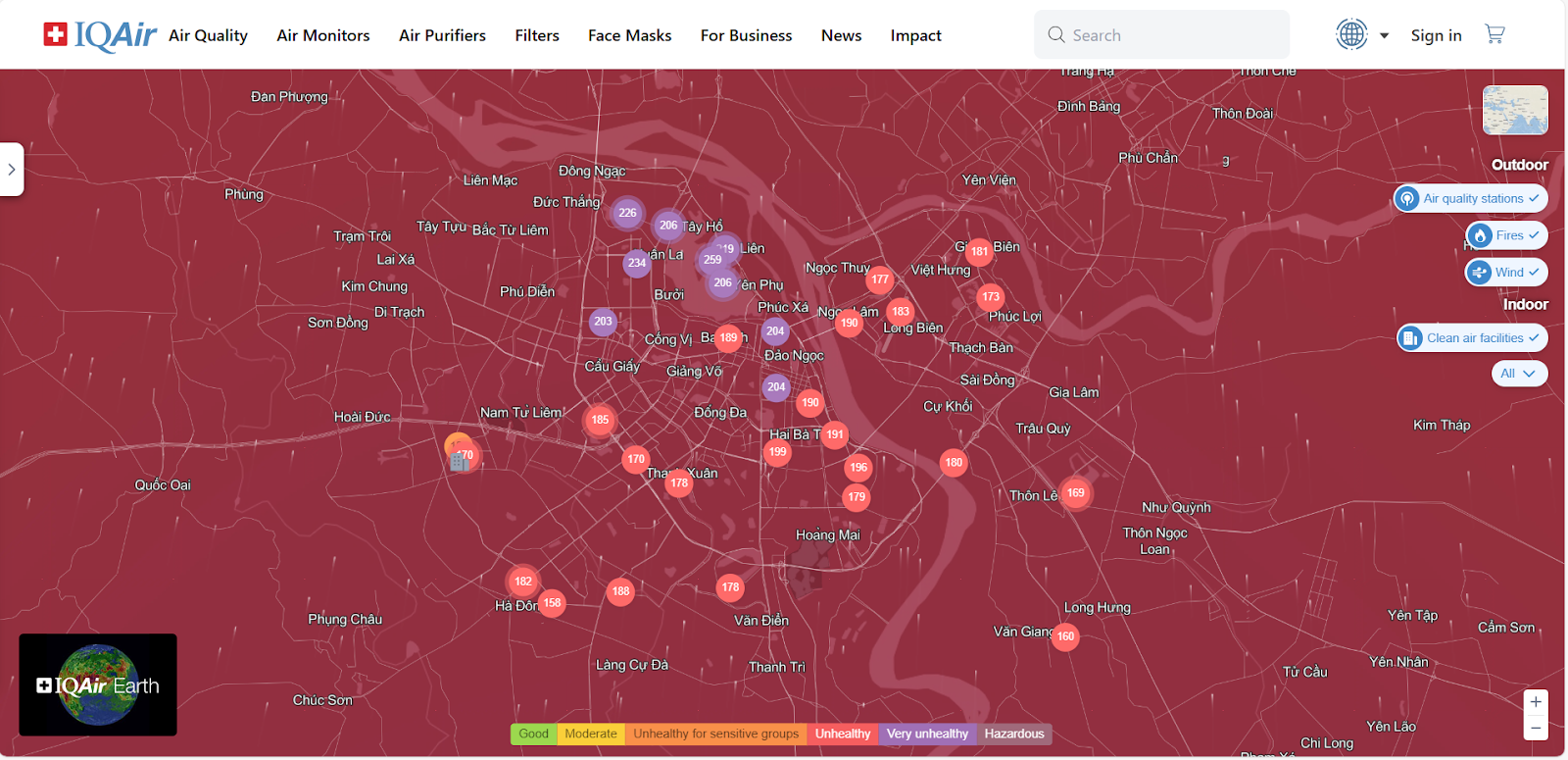
Air quality data at 9:00 AM on December 9, 2025 - According to IQAir.
According to Ms. Le Thanh Thuy from the Hanoi Department of Agriculture and Environment, the city previously implemented several emission inventory activities, but they lacked consistency and did not produce sufficiently robust scientific evidence. With international and regional experience, such as that of Beijing, Hanoi now has the basis to develop a smart, comprehensive, and effective inventory roadmap. The plan is expected to be implemented intensively in 2026, with the goal of identifying the major emission sources contributing to air pollution across the capital by the end of the year. In addition, a reporting mechanism for emission data will soon be introduced, enabling enterprises, organizations, production facilities, and even individuals to contribute to a comprehensive emission database for the city. (Source: Lao Động TV)
However, the limited number of fixed monitoring stations and the lack of continuous data remains a significant challenge for air pollutant inventory. Although Hanoi currently operates several monitoring stations, their spatial distribution is uneven, especially in areas with high traffic density, industrial zones, or construction sites. This limits model calibration, validation of inventory results, and key category analysis.

A dense layer of ‘fog’ has persisted over central Hanoi in recent days, sparking concerns about worsening air pollution in the capital. Photo: Huu Hoang.
Experts emphasize that a robust monitoring network strengthens inventory accuracy by enabling:
As Hanoi advances toward green urban development and evidence-based policymaking, investing in monitoring infrastructure, combined with modeling and data technologies, is fundamental to a modern emission inventory system.
As a green transition consulting firm with experience implementing projects in Vietnam and across the region, including collaboration with Citepa under the AFD-funded ASEAN Air Quality Improvement Programme (AQIP), KLINOVA believes that an effective emission inventory must be accompanied by a comprehensive, transparent, and integrated monitoring network. This not only supports regulators in policy formulation but also helps communities better understand local air quality conditions, contributing to collective efforts to improve Hanoi’s air quality.
- Ngo Nhung -





_cr_480x332.jpg)



_cr_480x332.JPG)