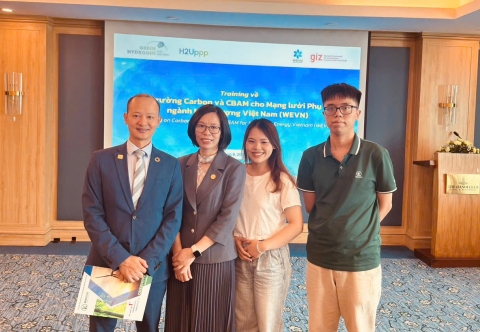
As the program’s lead trainer, Dr. Nguyễn Phương Nam – CEO of KLINOVA – delivered in-depth insights on ESG and emerging regulatory requirements affecting Vietnamese businesses. He emphasized that ESG has become an inevitable global trend, as intangible assets and brand reputation play a growing role in determining corporate competitiveness. ESG reporting, therefore, is not merely a disclosure exercise but a strategic tool for attracting investment, enhancing transparency and meeting evolving market expectations. Case studies of Vietnamese companies successfully integrating ESG into management and market expansion were also highlighted.

The presentation underscored the regulatory landscape shaping business operations, including Circular 96/2020/TT-BTC on sustainability reporting, Decree 47/2021/ND-CP on corporate social responsibility reporting, and Vietnam’s net-zero commitment under the National Climate Change Strategy. Dr. Nam also analyzed the impact of the EU’s Carbon Border Adjustment Mechanism (CBAM), which is expected to directly affect export sectors such as steel, cement, aluminum and fertilizers. He noted that businesses must begin building emissions data systems, conducting greenhouse gas inventories and improving production processes if they wish to maintain competitiveness in the European market.

The training further introduced concepts of green finance and the national green taxonomy under Decision 21/2025/QD-TTg. These frameworks are considered essential for helping businesses access green capital while meeting environmental criteria in project development. According to Dr. Nam, Vietnam faces substantial financing needs for its green transition, while international investors are showing increasing preference for companies with clear ESG strategies.
On the practical side, the session presented a roadmap for implementing ESG within enterprises—from assessing the current state, developing strategy and integrating ESG into operations, to monitoring and reporting outcomes. Businesses were encouraged to view ESG as a long-term strategic mindset closely aligned with their business model and product quality. Energy efficiency, emissions reduction and technological innovation were introduced as practical solutions to reduce operational costs and align with international standards.

The training program received active engagement from participating businesses, who raised questions on practical implementation, emissions data preparation and access to green finance. The involvement of Vietnamese experts such as Dr. Nguyễn Phương Nam was considered an important contribution, helping local businesses understand the issues correctly, prepare effectively and seize opportunities amid increasingly stringent sustainability requirements in global markets.


_cr_480x332.jpg)

_cr_480x332.jpg)
_cr_480x332.JPG)